Absurd Encounters of the Drunken Octopus Kind
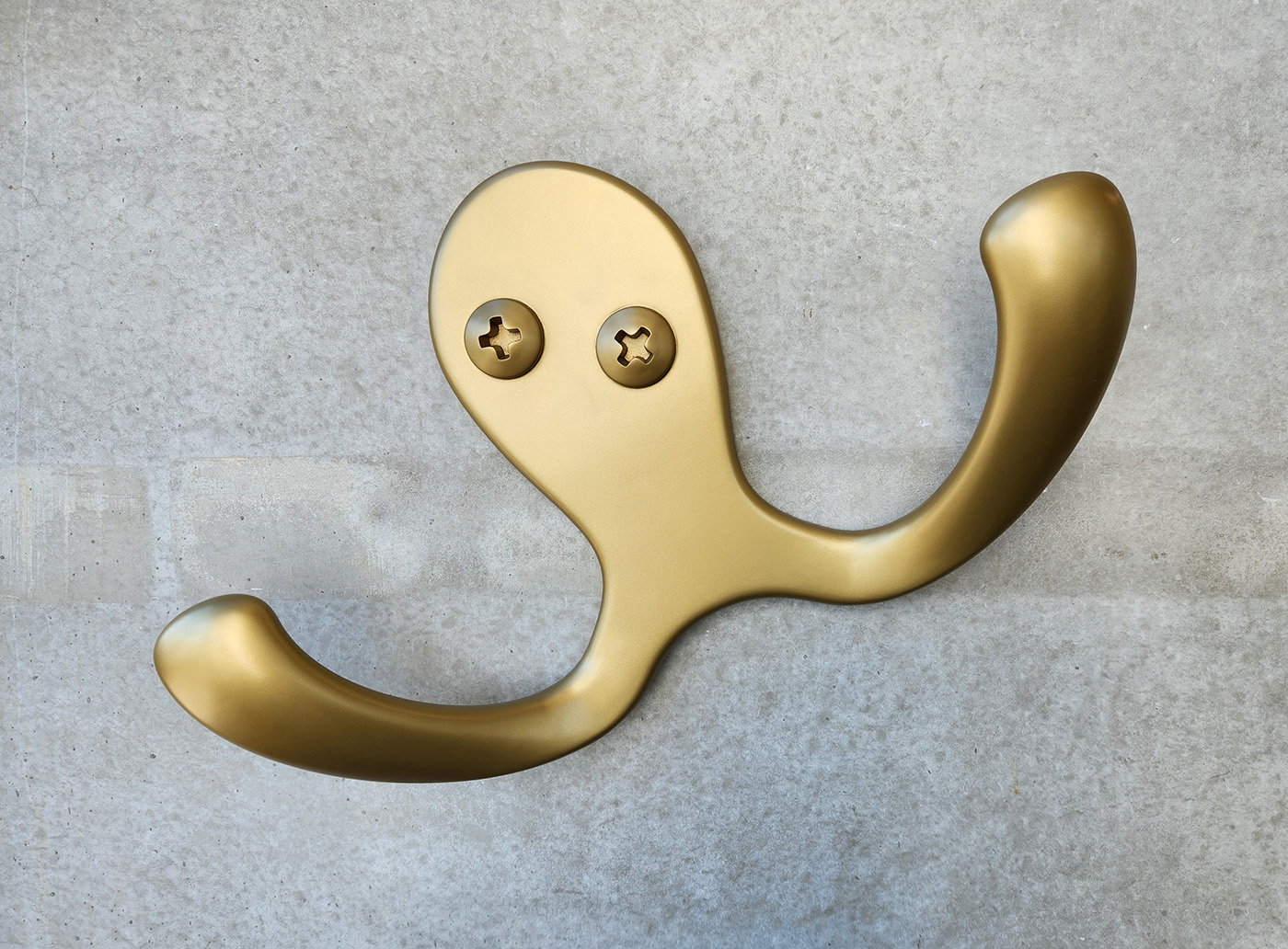
James R Ford, Double Hook, 2025
At first encounter, Double Hook appears disarmingly simple: a torso-sized replica of an ordinary brass double robe hook. It occupies roughly human scale: large enough to be physically present, yet small enough to retain its recognisable domestic identity. This inflation of scale produces an immediate perceptual shift. What once lived on a bathroom wall now asserts itself as something strangely animate. Its curved prongs twist forward like arms, its central stem reads as a spine, and the whole thing teeters between object and creature. Many viewers cannot avoid seeing it as what has been coined as “drunk octopus wants to fight.”
This slippage between object and being is not incidental. It is the work’s conceptual engine. Double Hook mobilises one of the most persistent and fascinating quirks of human cognition, apophenia, the tendency to see meaningful patterns where none were intended. Just as Ford’s Dot paintings invite viewers to search for figures and messages inside non-representational marks, Double Hook externalises that same compulsion in sculptural form. The hook does not depict an octopus. Rather, it activates the viewer’s own neural hunger for narrative, character, and intention. We want it to be something. We want to read it as a body, a mood, a threat, a joke.
This impulse is deeply embedded in Ford’s wider practice. From the Bogey Ball (2002-2004), a grotesque but intimate record of his own biological presence, to Look Here (2018), where viewers are tricked into staring at a drawn illusion of a hole, Ford has consistently exposed the mechanics of perception itself. We do not encounter reality passively. We impose structure upon it. Double Hook continues this inquiry, but with a blunt, slapstick elegance. The sculpture confronts the viewer with their own projection. The octopus is not there. It is something the brain insists on manufacturing.
The fact that the phrase “drunk octopus wants to fight” originated as an internet meme over a decade ago is crucial. Ford is not inventing this interpretation. He is preserving and recontextualising a fleeting piece of collective cognition. A throwaway internet joke, once scribbled beneath a misaligned hook, is now cast to near-bodily scale and given physical authority. This gesture echoes Ford’s long interest in how small, irrational ideas lodge themselves inside us. In Double Hook, a single silly thought, “this looks like an octopus”, refuses to die.
Here the work edges into Absurdism, the philosophical territory that underpins much of Ford’s practice. Albert Camus described the absurd as the collision between humanity’s desire for meaning and the world’s indifference to providing it. A bathroom hook has no intention of resembling an animal, yet the human mind cannot help but animate it. That this animation takes the form of a drunken, aggressive creature only heightens the absurdity. We are not just meaning-making machines, we are ridiculous ones.
Double Hook also sits within a lineage of sculptors who enlarge, anthropomorphise, or recontextualise everyday objects. Claes Oldenburg’s hamburgers, clothespins, and toilets transform the familiar into something uncanny and slightly ridiculous. Jeff Koons’ polished balloon dogs and vacuum cleaners fetishise banal objects, turning them into seductive icons. Erwin Wurm’s One Minute Sculptures engage everyday items through the human body, creating temporary absurd hybrids. Where Ford aligns with these traditions, he introduces a distinctive combination of humour, awkwardness, and narrative tension.
Crucially, Ford’s use of contemporary fabrication, 3D-printed plastic and automotive paint, situates the work firmly in the present. This is not a nostalgic enlargement of a household relic. It is a digitally mediated, industrially finished object. The hook has been reborn as a simulacrum of itself, detached from its original function and reinserted into a system of gallery experience. In this sense, Double Hook also echoes Jean Baudrillard’s notion of the simulacrum, a copy whose meaning now outweighs its source. We no longer care about the hook as a hook. We care about it as an octopus, a meme, a joke, a sculpture.
This doubling, object and creature, joke and sculpture, banal and fetishised, mirrors the internal contradictions that run through Ford’s artistic practice. The gilded form of The Dangling Carrot (2022-2023) both critiques and embodies desire. Look Here exposes deception while deploying it. Double Hook does something similar. It mocks our tendency to anthropomorphise while relying entirely on that tendency to function.
Ultimately, Double Hook is not about a coat hook at all. It is about the tragicomic condition of being human in a world of things. We are condemned to read ourselves into objects, to project emotions onto metal and plastic, to invent stories where none exist, and then to be quietly haunted by them. The drunk octopus never stops wanting to fight, because it lives not in the sculpture, but in the viewer’s mind.
And like so many of Ford’s works, that is where the real absurdity lies.